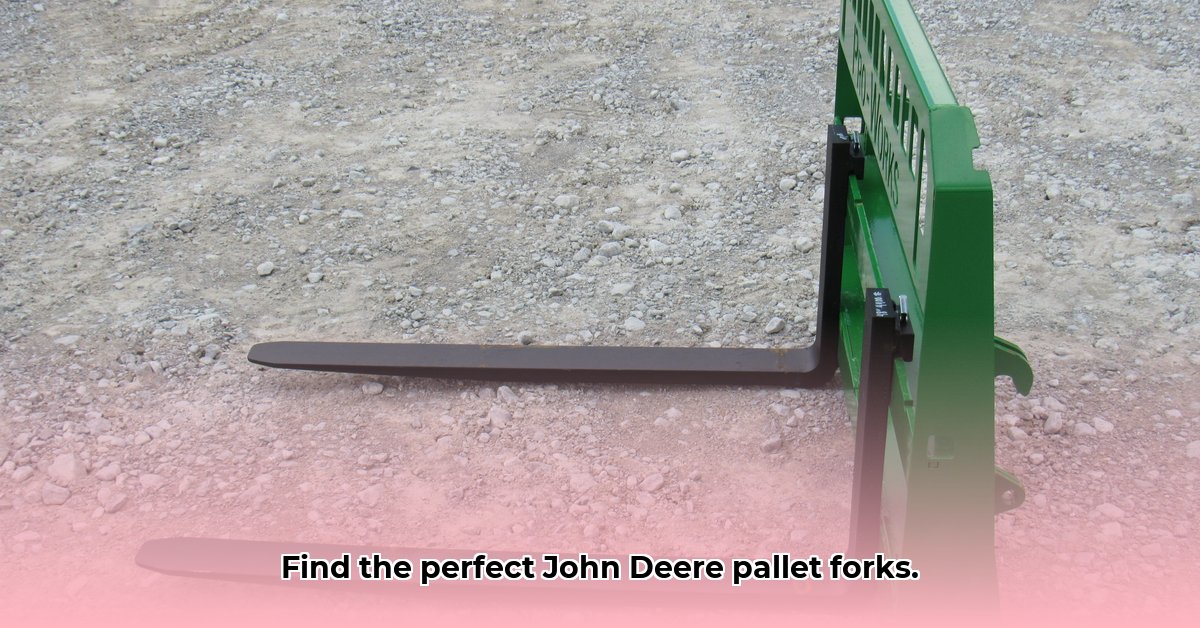
Choosing the right pallet forks for your John Deere tractor can be overwhelming. This comprehensive guide simplifies the process, helping you find the perfect match for your needs and budget. We'll compare John Deere's offerings with third-party options, focusing on key features, compatibility, and total cost of ownership. For more information on John Deere equipment, check out this helpful resource: John Deere Keys.
Lifting Capacity and Handling: Choosing the Right Weight and Tine Type
The first step is assessing your typical lifting needs. How heavy are the loads you'll be moving? This directly impacts fork capacity. John Deere's AP12/AP13 series offers a wide range, from 3750 lbs to 10,000 lbs, providing flexibility for various applications. Many third-party "Standard Series" forks typically top out around 4000 lbs. Higher capacity means handling heavier loads, but may reduce maneuverability. Do you frequently handle heavy loads like large hay bales? A higher capacity is crucial. However, are you primarily working in tight spaces? A lower capacity might be more practical.
Next consider tine type. Fixed tines are simpler and cheaper, ideal for level ground. Floating tines, often found on John Deere's AP13 series and some third-party options, adapt to uneven terrain, enhancing stability and reducing stress on your tractor. What kind of terrain will you predominantly use your forks on? This decision will directly affect which tine type best suits your needs.
Beyond the Basics: Essential Features and Their Impact
Capacity and tines are important, but additional features significantly impact functionality and ease of use. Many forks include integrated hitches or headache racks (a safety and convenience feature). Headache racks provide an extra support platform for securing oversized loads, such as hay bales. Are these additional features beneficial to your tasks? The "Standard Series" frequently includes such features standard. John Deere models may require these to be purchased separately.
Here's a concise comparison:
| Feature | Deere AP12/AP13 Series | Standard Series |
|---|---|---|
| Lifting Capacity (lbs) | 3750 - 10000 | Typically around 4000 |
| Tine Type | Fixed (AP12), Floating (AP13) | Varies; check specifications |
| Additional Features | Varies by model | Often includes hitch, headache rack |
| Price | Generally higher | Typically lower |
Ensuring a Perfect Fit: Tractor Compatibility is Crucial!
Before purchasing, verify that the chosen forks are completely compatible with your specific John Deere tractor model and loader. Manufacturer specifications and your tractor's loader model number are your guides. Ignoring compatibility could result in costly returns and project delays.
Total Cost of Ownership (TCO): Looking Beyond the Initial Price
The initial purchase price is only part of the equation. Consider TCO, encompassing maintenance, repairs, and fuel consumption. Higher-capacity forks might consume more fuel. While the additional features of a "Standard Series" fork increase upfront cost, those features could save time and labor in the long run. Evaluate the long-term benefits against initial cost.
Your Step-by-Step Guide to Selecting the Right Pallet Forks
Follow these steps for a successful purchase:
- Assess Your Needs: Determine the weight of typical loads and working conditions.
- Verify Compatibility: Confirm compatibility with your tractor's loader model.
- Compare Features: Prioritize essential functionality (floating tines, hitches, etc.).
- Calculate TCO: Consider long-term costs alongside initial investment.
- Choose Wisely: Select forks that meet your needs and budget.
Expert Insights: Maximizing Efficiency and Safety
"Choosing the right pallet forks is a balancing act between capacity, features, and cost," says Dr. Emily Carter, Agricultural Engineering Professor at Purdue University. "Carefully evaluating your needs and considering the long-term implications will ensure you get the most out of your investment." This expert opinion emphasizes the importance of a strategic, long-term perspective.
Conclusion: Making the Right Choice for Your Operations
Selecting the correct pallet forks is a significant investment that impacts efficiency and safety. By thoughtfully evaluating capacity, essential features, compatibility, and TCO, will you secure the best long-term solution for your specific, individual needs.